SurView DIC
Software for digital image correlation: full-field displacement and strain measurement from speckle images.
Free and open source, LGPL-2.1-or-later · Qt and VTK · correlation by OpenCorr
Capabilities
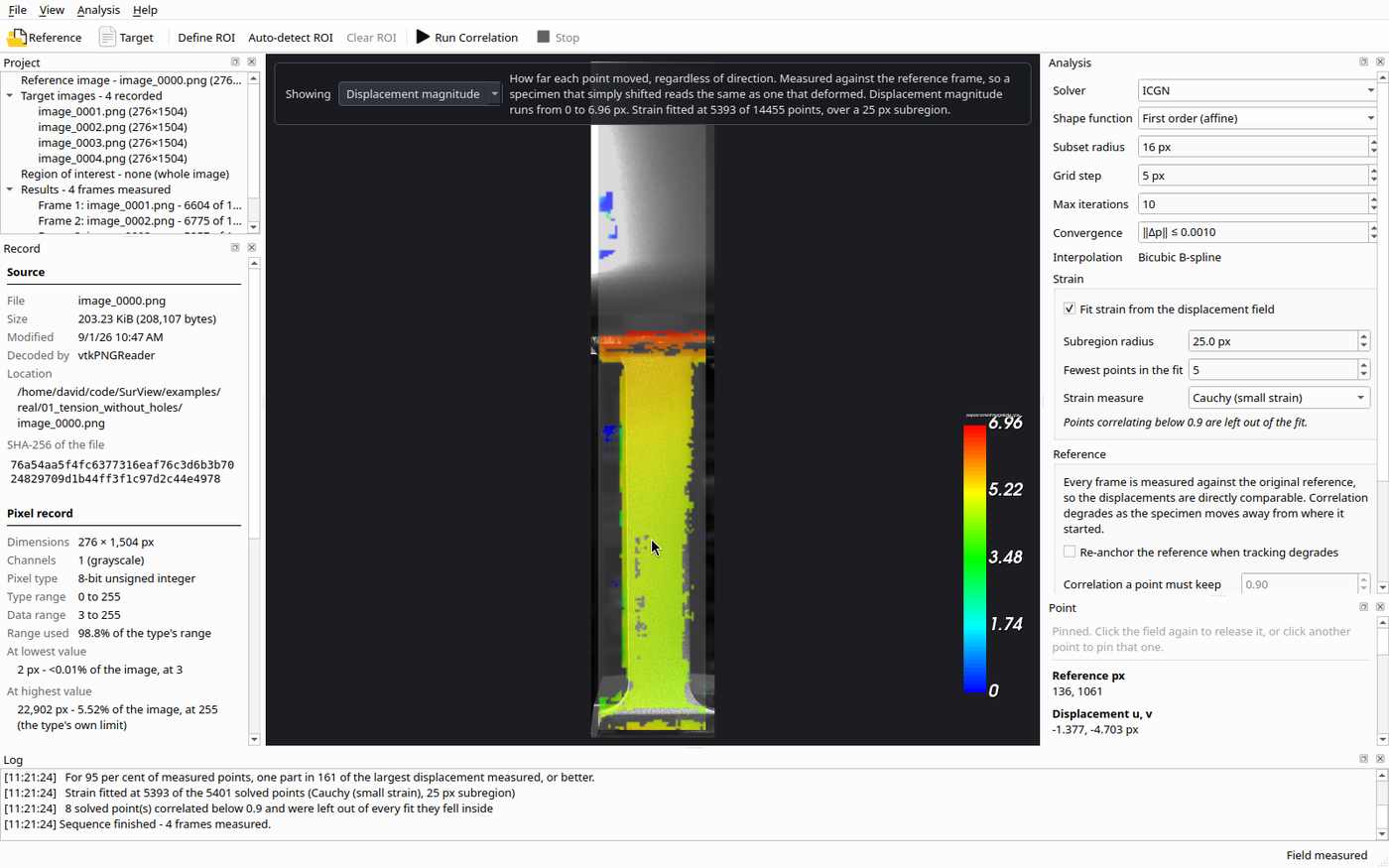
SurView DIC measures how a speckled specimen moved and deformed between photographs, over a whole loading sequence, reads it back as a loading curve, and reports how far each measured point can be trusted.
- Two-dimensional subset correlation over a regular grid of points
- Region of interest drawn by hand or segmented automatically from speckle quality
- Whole loading sequences measured against one reference, in frame order
- Reference updating when correlation against the original frame degrades
- A second pass that repairs points the first solve could not measure, and says which they were
- Strain fitted from neighbouring displacements, in three measures
- Per-point noise floor and match conditioning, computed on every run
- Per-point readout of every measured channel, pinnable
- Any quantity plotted against frame, over the whole sequence
- Virtual extensometers placed with two clicks, read as a loading curve
- Provenance recorded for every image, verified by SHA-256
- Export to VTK unstructured grid and to comma-separated text
- One numbered file per frame, which ParaView groups as a time series
Specification
What the correlation actually does, in the terms the literature uses.
.vtu VTK unstructured grid, and .csv. Both carry both images with their SHA-256, the solver and its settings, the region, the strain fit and the engine revision.surview-dev: our working fork of
OpenCorr (Jiang,
MPL-2.0). Required, and not interchangeable with upstream today -
auto-detected regions, per-point reliability and per-point failure
reasons are all capability work that lives in the fork. Pinned to an
exact commit, recorded in the repository and compiled into every
export.
The record, and the measurement
A measurement is worth what the record behind it is worth, so SurView keeps both in view.
What was recorded
Every image is recorded as it arrived: path, size, modification time, SHA-256, the decoder that read it, its pixel type, and how much of that type's range the data actually used. Nothing is converted, resampled or normalised on the way in.
What was measured
Nothing unmeasured is reported as a number. A rejected point, an unfitted strain, an unestablished uncertainty and a frame an extensometer could not read are absent or not-a-number, never zero, in the display, in every plot and in every exported file. Failures are counted by the engine's own reason, and a point repaired by the second pass is marked as one everywhere it appears.
Screenshots
From a running build, measuring the example data that ships with it.
A loading curve, from two clicks
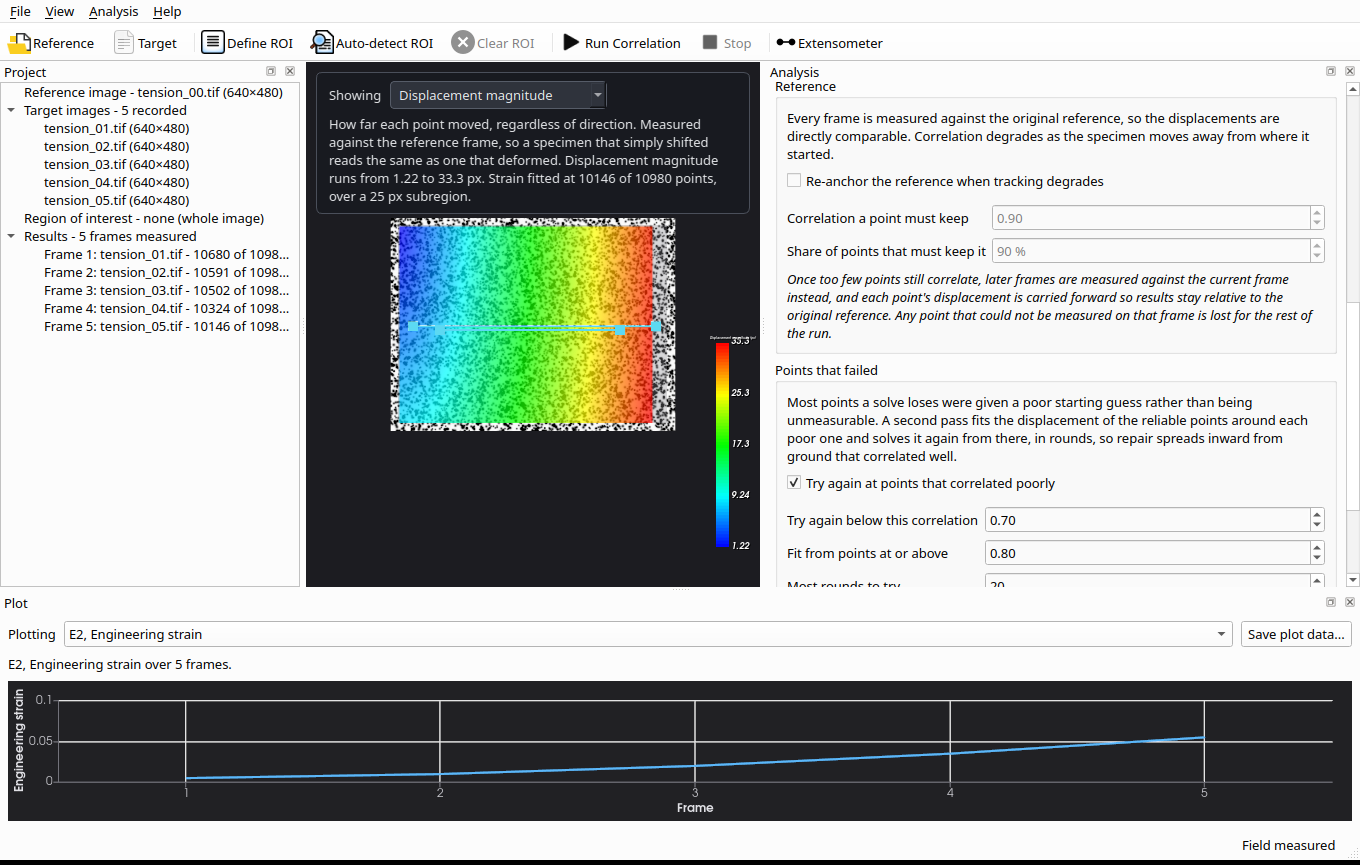
Place a virtual extensometer on the specimen and SurView reads the change in the distance between its two points across every frame, as gauge length, elongation or engineering strain. It measures the distance BETWEEN the anchors, so a specimen that simply moved reports no strain at all. A frame the gauge cannot read breaks the curve and is counted in words beneath it, rather than being joined across as though it had been measured.
This is the synthetic tension set, whose exact strain per frame is stated in the data that ships with it. Over the first four frames the gauge reads 0.005, 0.010, 0.020 and 0.036 against stated strains of 0.005, 0.010, 0.020 and 0.035, and a test in the repository holds it to that.
Which points were hard won
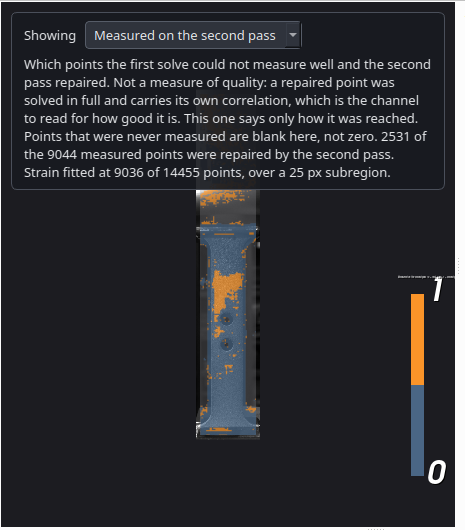
Most points a solve loses were given a poor starting guess rather than being unmeasurable. A second pass fits the displacement of the reliable points around each failure and solves it again from there, in rounds, so repair spreads inward from ground that correlated well. Here it recovered 2531 of 9044 measured points.
A repaired point is a real measurement with its own correlation, and it is marked as one on the map, in the readout, in the run report and in both export formats. Where the repairs fall tells you something the count cannot: clustered at the holes and edges, as they are here, is the specimen talking.
The exported field, in ParaView
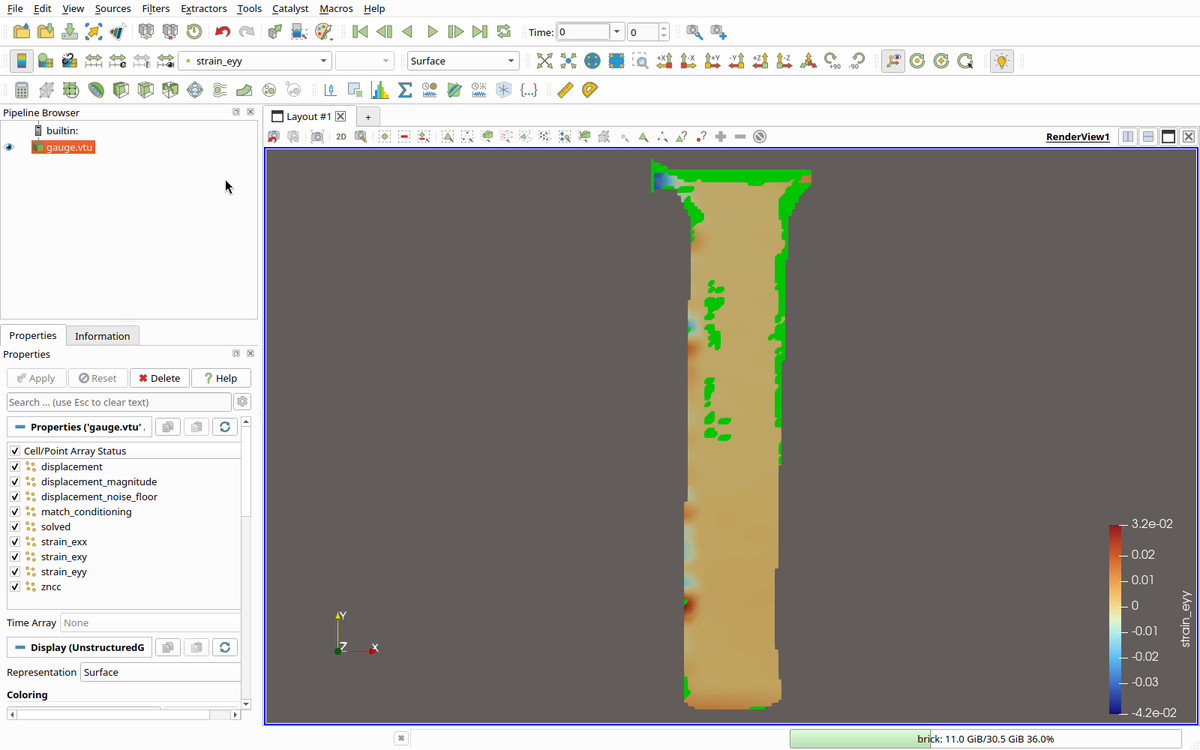
SurView's own export, written from the File menu and opened with no conversion step: the format is VTK's own. Every channel the run measured is in the array list, and so are the provenance strings.
The gaps are unmeasured points. They are not-a-number rather than zero, so they arrive as holes rather than as a flat region no reader could tell from a measurement.
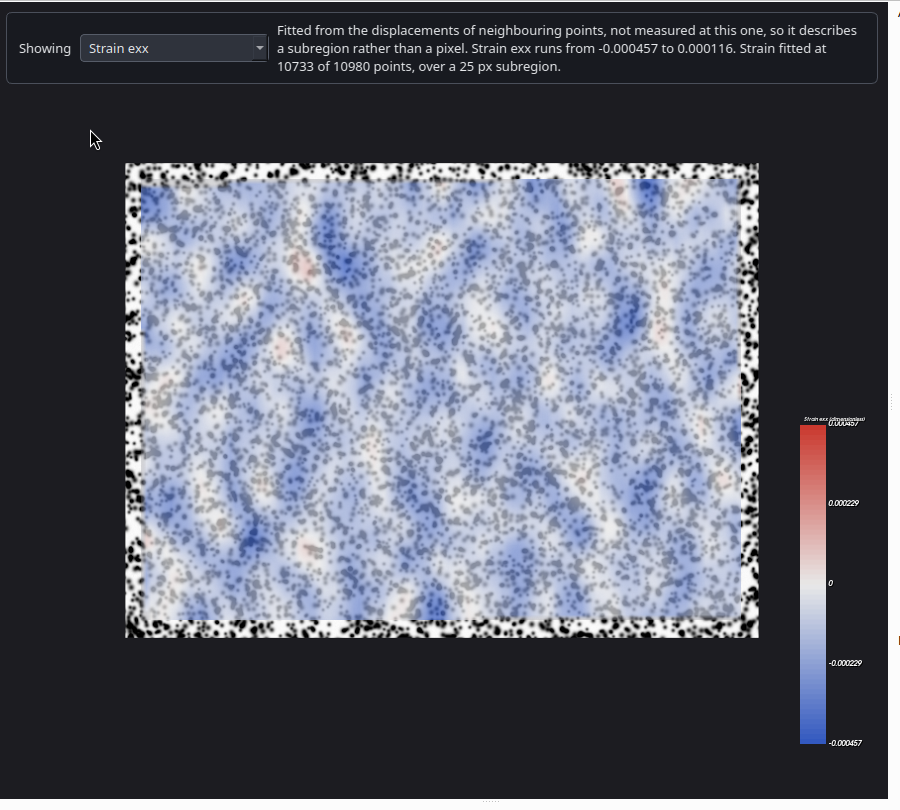
A rotation is not a strain
A specimen turned, not deformed. Strain runs from -0.000457 to 0.000116 across the whole field: zero, to within the method's own noise.
The scale is centred on zero because strain's zero is a physical state. Displacement's is not, so it is scaled differently.
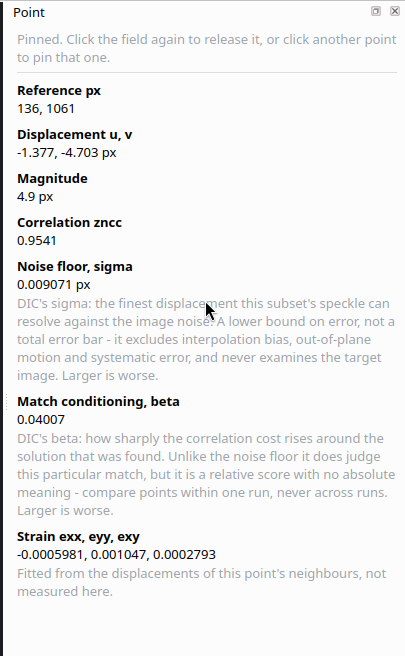
Every number, and what it is not
Point at the field for that point's own measurement: displacement, correlation, the noise floor of its subset, how well conditioned the match was, and the strain fitted around it. Click to pin a reading.
Each value carries one sentence on what it does not cover. The noise floor is a lower bound on error, not a total error bar, and it never examines the target image; the conditioning is comparable within a run and meaningless across runs.
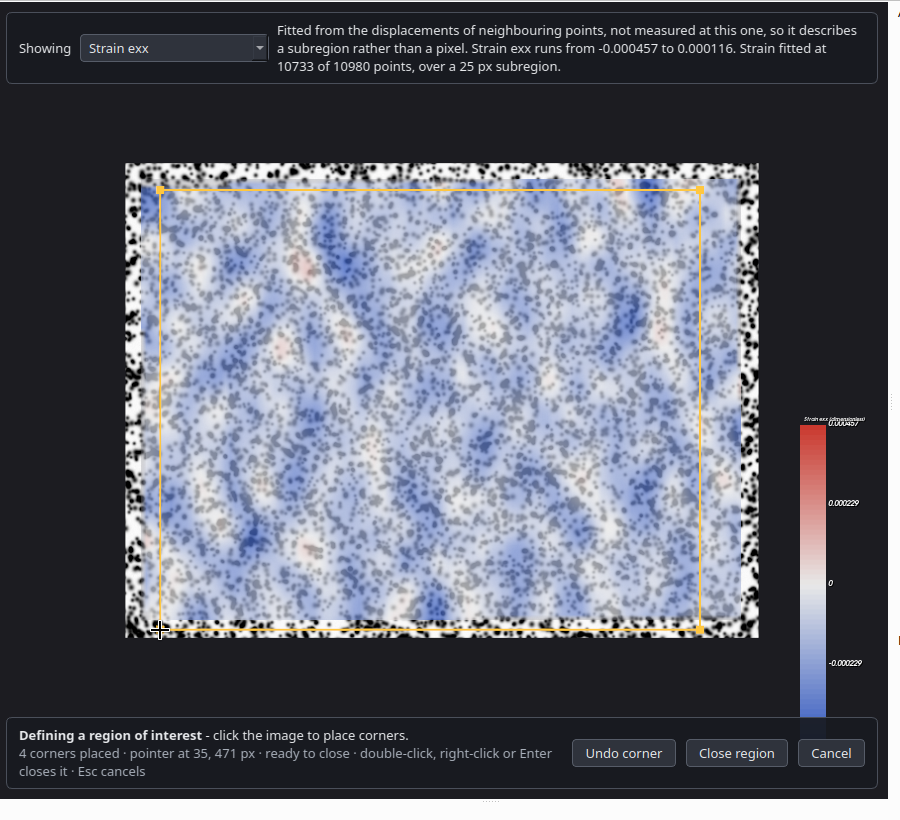
Regions, drawn or detected
Click corners to bound the specimen, or let SurView segment the speckled area from an image-gradient quality map. The mode carries its own instructions, a live corner count, the pointer's position in image pixels, and every way to finish it.
Example data
Two kinds, because they answer different questions. Both ship with the source.
Six synthetic sets, with the exact answer
Rendered from an analytic speckle pattern rather than warped from an image, so no pixel is ever resampled and the displacement is exact by construction. Each frame carries its deformation gradient, its displacement at the corners and centre, and a noise floor measured from its own pixels.
- Sub-pixel translation, 0.25 to 2.5 px
- Uniaxial tension with Poisson contraction
- Rigid rotation to 15 degrees, no strain at any step
- Simple shear
- Large strain to 30 per cent, for reference updating
- Movement straddling what the speckle can resolve
Three real experiments
Photographs of actual specimens, with what a real camera brings: lighting, grips, out-of-plane motion, and background carrying no speckle at all.
- Aluminium dog-bone in uniaxial tension
- Perforated specimen, stress concentration at the holes
- Speckled plate in rigid-body rotation
From the pyALDIC project, BSD-3-Clause, cited with the data.
Download
SurView builds from source against a pinned engine revision, so a build is always traceable to one exact correlation library. Both clones are required: the second is the correlation engine, and SurView will not configure without it.
git clone https://github.com/katalystnord/SurView.git
git clone -b surview-dev https://github.com/katalystnord/OpenCorr.git

cd SurView
cmake -S . -B build -G Ninja -DCMAKE_BUILD_TYPE=Release
cmake --build build

./build/src/SurView examples/real/01_tension_without_holes/image_000*.png
The last line opens a real tension sequence with its reference and four loaded frames already imported. Press Run Correlation.
The engine clone is katalystnord/OpenCorr rather than upstream on purpose. It is our working fork of Jiang's OpenCorr, and several things SurView shows on screen are implemented there. Upstream will not build this application as it stands. Fixes that are generally useful go upstream as pull requests rather than staying in the fork, and a script in the repository checks all three links - upstream to fork, our upstreamed fixes by content, and fork to the pinned commit.
Sister tool
SurView DIC and PatternFab are two ends of one workflow: the speckle pattern PatternFab makes is the pattern SurView measures.
SurView DIC
Speckle images in, displacement and strain fields out, with every point's reliability reported and full provenance carried into ParaView and FreeCAD.
This tool.
PatternFab
An optimized speckle pattern into a 3D-printed stamp, a laser-cut stencil, a decal or a direct-write file, with the manufacturing constraints applied before anything is made.
katalystnord.github.io/patternfabLicence and credits
Correlation is by OpenCorr (Jiang, MPL-2.0): 2D, stereo and volumetric DVC in one library, and the work to cite for the method.
SurView builds against our working fork of it, which carries the capability work this application needs. It is a staging area for that work and for fixes on their way upstream, not an attempt to run a competing version of OpenCorr.
The application shell is Qt and everything rendered or exported goes through VTK, which is why results open natively in ParaView and FreeCAD rather than through a converter.
SurView DIC is LGPL-2.1-or-later, the licence FreeCAD chose in the same ecosystem. No paid tier and no open core.